PRE-CONGRESS COURSE 12.09.2019
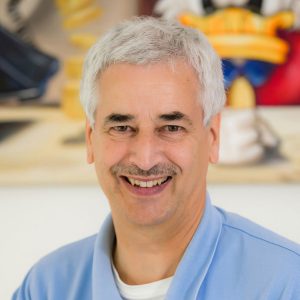
Dr. Wolfgang Grüner; D.D.S is well known in field of orthodontics as a distinguished lecturer who introduced many colleagues with the secrets of different orthodontic secrets and skills.
After the high school graduation in Oak Park, USA and in Schramberg, Germany, he continued his education in Dental Medical School at Freiburg University and become a Doctor of dental Sciences in 1982.
Attended postgraduate studies at the same University where he worked as an Assistant at the University Hospital Tübingen and he finished his specialization in Orthodontics at Tübingen University in 1987.
He realizes himself as a founder of his own orthodontic practice in 1987, but he didn’t stop there. From 1991 he becomes a lecturer for Post Graduate Studies in Orthodontics and Consultant for the Department of Orthodontics at Dentaurum.
Since then he had frequent lecturing on various Orthodontic Topics in Germany and many European Countries. Some of them are:
- typodont course I – Straight Wire Arch technique I – with many practical exercises – ideal for beginners
- Typodont course II – Straight Wire Arch Technique II – with many practical exercises – optimally as a build-up training for Typodont course I
- Typodont course III – Classification of displaced teeth – how to avoid extraction therapy
- Typodont course IV – special bending course
- Tomas®-pins – skeletal anchorage – advanced options in orthodontics
BRIEF DESCRIPTION OF THE COURSE:
Lingual/palatal arches can be used instead of removable appliances. Typical tooth movements like protruding an incisor, tipping a premolar to the baccal side, solving a molar cross-bite can be done without depending of the patient cooperation.
Lingual/palatal arches can also help tooth movements with multi bracket appliances. The control can be gained from the transfersal dimension in the molar section of the initial arch.
Torque provided only by the rectangular arch wire of the multi-bracket appliance is not very effective. The effect can be increased by lingual/palatal arches. Asymmetric sagittal movements and of course the increasing of sagittal anchorage can help to correct the bite.
In the course the various preformed lingual/palatal arches are introduced and examples are presented and how you can achieve benefits from them. You will learn how to adapt them properly, so the patient has least discomfort and how to activate the arches to have the desired ones.
NECESSARY INSTRUMENTS FOR THE COURSE:
- Mathieu needle holder is a must ( Dentaurum 000-030-00)
- Arch forming plier is a must ( Dentaurum 003-185- 00)
- Flat plier is a must ( Dentaurum 013-522-00)
- Loop forming plier medium ( Dentaurum 003-053-00) or
- Loop forming plier Maxi ( Dentaurum 003-233-00) or
- Angle wire bending pliers ( Dentaurum 004-139-00 ) or
- Angle wire bending pliers standard ( Dentaurum 004-139-00 )
- Young loop bending pliers ( dentaurum 012-074-00) or
EXERCISES
TPB
a) Passive adaptation
b) Transfersal expansion with torque
c) Assymetric rotation
Quad Helix
a) Expansion in the molar section
b) Expansion of the cuspid section
Orthorama palatal arch
a) Palatinal tipping in the upper second molars
b) Buccal tipping of a single premolar
c) Assymetric rotation
Lingual arch
a) Passive adaptation
b) Lingual tipping of the molars
Orthorama multi action lingual arch
a) Buccal tipping of lower second molars
Orthorama sectional arches
Permanent retention of a missing premolar gap until implant is being inserted